
Deut. 8-2-3, 14b-16a; Ps. 147: 12-15, 19-20; 1 Cor. 10: 16-17; Jn. 6: 51-58
Never forget the test that the Lord gave the people of Israel for forty years in the desert while still providing for them with manna and water. It was a test of obedience to the commandments and love of the Lord. Never forget the power of God to set us free not simply from the slavery of the human condition but from the attachment to sin.
Never forget to praise the Lord for the cup of blessings that comes from the hands of a priest to give us the most Holy Body and Blood of Christ. It was Jesus who instituted his priesthood in the disciples he chose to make himself present even as he died and rose to heaven through his body and blood in the Eucharist. No priest, no Eucharist, no real presence of Christ as body and blood. This is the great tragedy of our times that the Christian world has abandoned the command of Jesus to make him present as body and blood in the bread and wine.
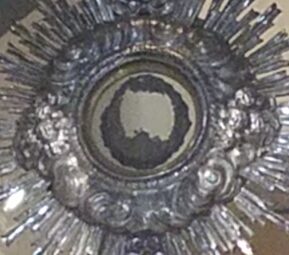
Never forget the promise of Jesus as the “living bread” that comes down from heaven in the Eucharist. This is what he calls us to eat to receive eternal life. This is the sacrifice of Jesus which the Jews could not accept then and the world continues to deny. We have only to recall the many Eucharistic miracles where the Eucharist turns into flesh and drips blood to confirm our faith in the words that Jesus spoke “whoever eats my flesh and drinks my blood has eternal life”.
“Do this” is to make Jesus alive in the Eucharist, to receive him and proclaim his sacrifice and death until he comes. Jesus coming is always a present event for he comes in the Most Holy Body and Blood in the Eucharist. Having just visited many holy shrines in Italy, one place visited was Lanciano, Italy. Here is the “Miracle of Lanciano” where the sacred host changed into flesh and blood. Able to stand within feet of the reliquary which holds to this day the flesh and blood you see the fleshy host and below it five globules of blood intact. Within the miracle itself scientist weighed each of the five separate parts and found that each part weighs the same as all five together. They also determine that the fleshy host is human cardiac tissue of type AB blood and they can point exactly what spot of the heart muscle tissue it comes from. This is consistent with all other Eucharistic miracles in the church. What are we to believe? More importantly do we believe Jesus is “the living bread” in the Eucharist “that came down from heaven” and the source of eternal life when we “eat this bread”? This is our celebration today!
In the gospel, Jesus blesses the five loaves and two fish and it is multiplied to feed the five thousand plus. God is the creator of natural law thus his power is outside of the natural law. We are bound by natural law but he is not bound by the object of his creation.
Years back we went on a pilgrimage to Israel. Our guide was a very well educated older Jewish man with a sense of humor. He was also in much better physical shape than a lot of us younger people. During daily Mass he always sat in the back but remained in church. He had a good understanding of Christian history and was a very good guide. When discussing the church faith in transubstantiation, that is the changing of the bread and wine into the body and blood of Jesus in the Eucharist, it was a stumbling block for him. His response was “it cannot be that easy”. It is that easy if it is the will of God. What happens the next day after the multiplication of the loaves? The people want a sign from heaven to believe in him. Jesus responds by saying, “Whoever eats my flesh and drinks my blood has eternal life, and I will raise him on the last day” and again repeats “Whoever eats my flesh and drinks my blood remains in me and I in him”. (Jn. 6: 54, 56) How did many of his disciples respond?” They said, “This saying is hard; who can accept it?” Many left and “returned to their former way of life and no longer accompanied him.” (Jn. 6:66) How do we respond to the invitation today? Do we follow the teaching of Jesus or do we go through the “cafeteria line” and pick and choose only what we can accept?
Today this teaching is a stumbling block for many other Christian denominations. Some take crackers and grape juice to reflect communion as a symbolism skipping over Jesus’ teaching. The literal meaning is too hard to accept. Some say the Word of the gospel is the body of Christ as we consume his word to transform us. We receive both in the Liturgy of the Word and the Liturgy of the Eucharist for the fullness of truth. Do we believe what we profess every day in all the tabernacles of the world? The miracle is present for us today who believe and receive the Most precious Body and Blood of Jesus.
Recent Comments